Your Cart is Empty


Quick answer: The best eye cream for dark circles depends on what is creating the darkness. Choose hydration and barrier support for dry, crepey under-eyes; a carefully introduced retinoid for fine lines and texture; caffeine for temporary puffiness; or a pigment-focused formula for brown discoloration. No eye cream can remove a deep tear-trough shadow or change inherited bone structure.
Evidence and product information reviewed September 26, 2026. Formulas and availability can change, so confirm the current package ingredient list before buying.
| Your main concern | What to look for | What an eye cream cannot do |
|---|---|---|
| Dryness and dehydration lines | Glycerin, hyaluronic acid, ceramides, and other well-tolerated moisturizers | Remove pigment or reshape a tear trough |
| Brown or gray-brown pigment | Daily sun protection plus a gentle brightening formula appropriate for the eye area | Guarantee complete pigment removal |
| Blue, purple, or vascular-looking darkness | Camouflage, hydration, and carefully evaluated formulas marketed for vascular color | Prove that visible vessels are the cause without an assessment |
| Morning puffiness | A lightweight formula, caffeine, or a cooling applicator for temporary cosmetic improvement | Treat persistent, painful, or one-sided swelling |
| Fine lines and age-related texture | An eye-area retinol or peptide formula, introduced slowly | Replace lost volume or remove excess skin |
| Hollowness or structural shadow | Makeup or professional consultation rather than another cream | Change bone structure or fill a deep tear trough |
If you are unsure which type you have, begin with Herbal Dynamics Beauty’s evidence-based guide to what causes dark circles under the eyes.
Choose the cause you want to address, then compare the moisturizing base, eye-area directions and evidence for the finished formula. A long active list, a premium price or optical brightness does not prove lasting pigment or wrinkle improvement. Keep known allergens and irritation risk in view.
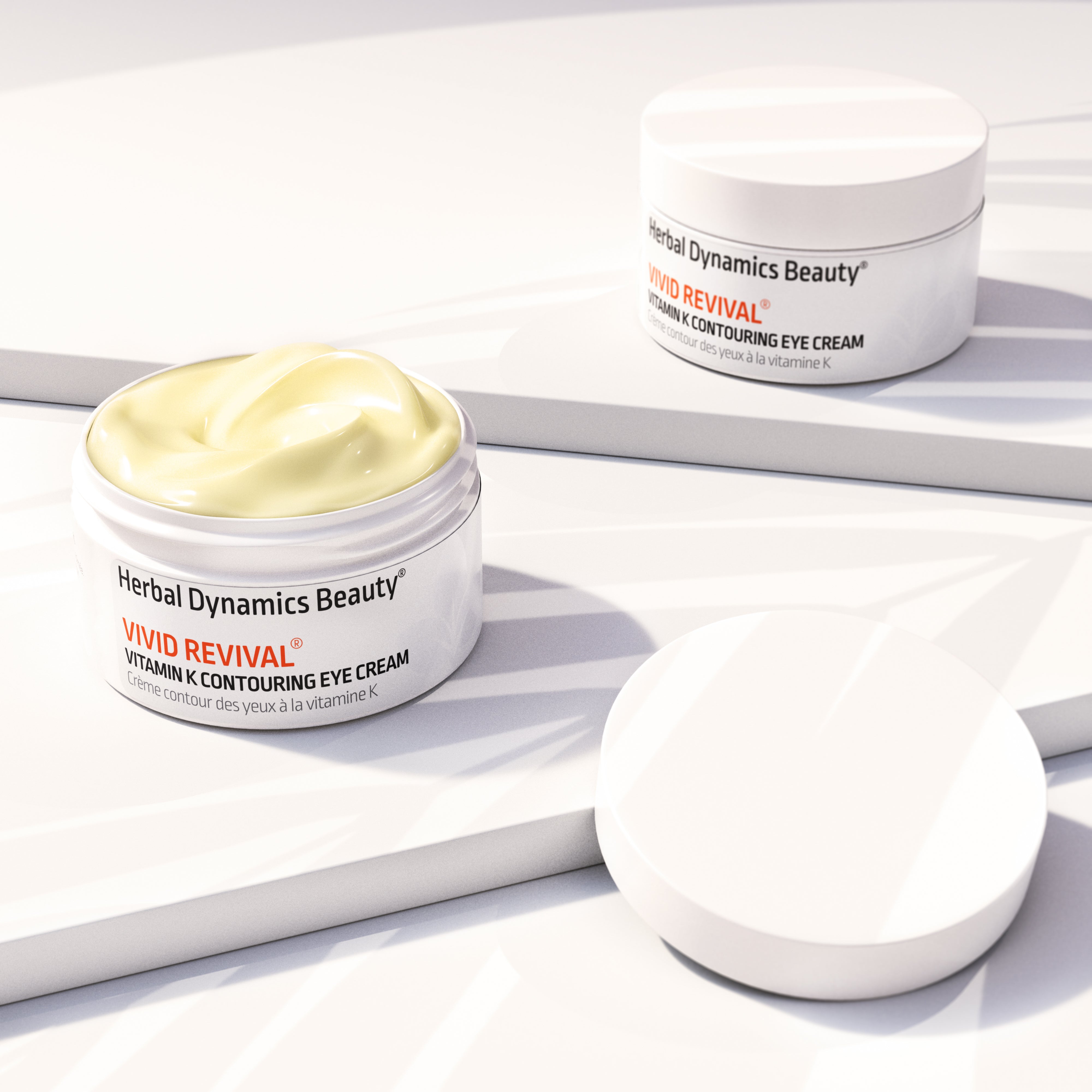
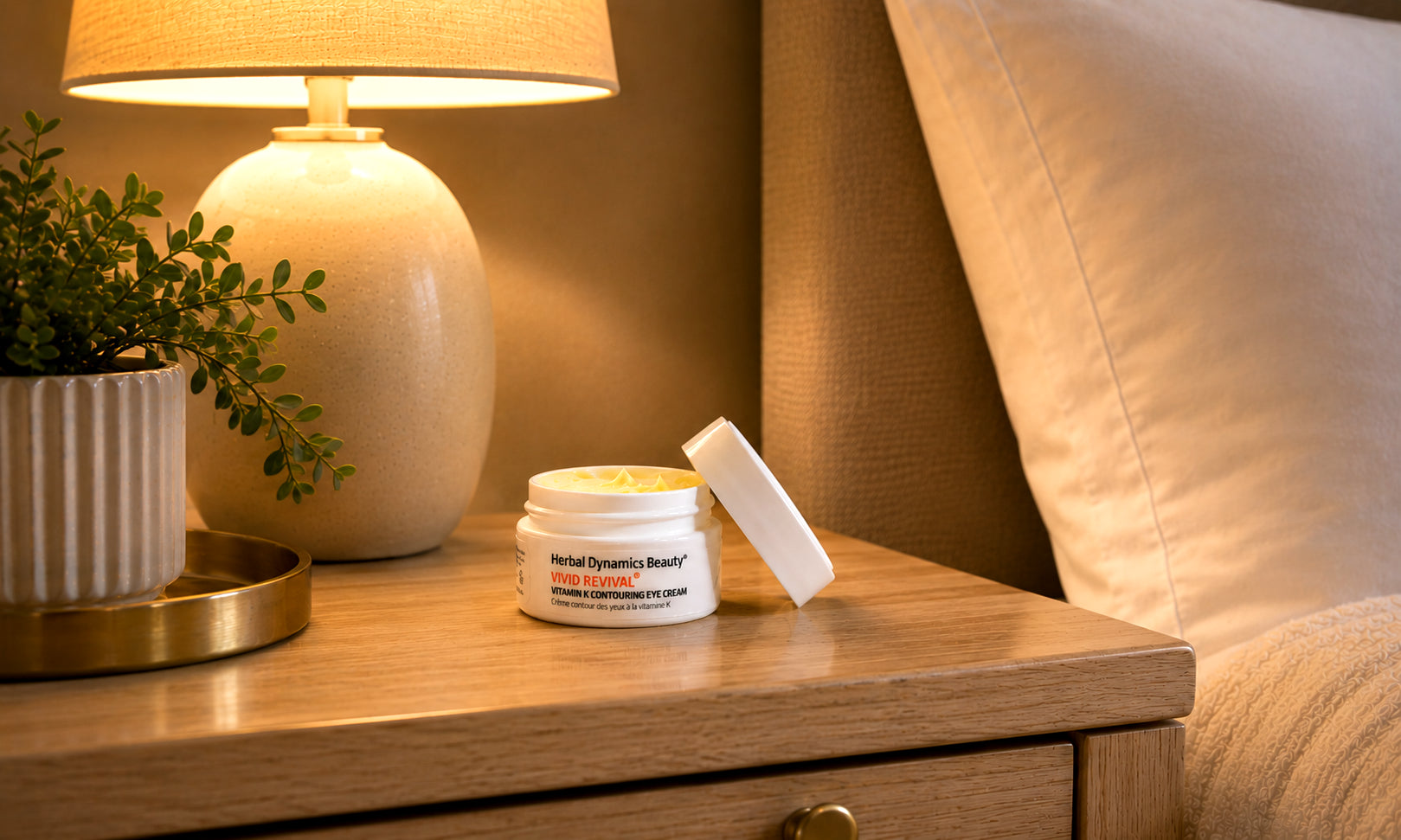
Our Vivid Revival® Vitamin K Contouring Eye Cream is an eye-area moisturizing cosmetic containing phytomenadione, glycerin, hyaluronic acid, green tea and other botanical ingredients. It also contains retinyl palmitate. It may fit someone seeking that moisturizing format who tolerates the complete formula; it cannot correct every cause of dark circles.
Vitamin K evidence is preliminary and does not establish that this finished formula treats vascular discoloration. Phytomenadione has contact-allergy concerns and is prohibited in EU cosmetics. Read the vitamin K evidence and safety guide. Avoid retinoids during pregnancy or while trying to conceive and discuss breastfeeding with a clinician.
For a closer look at this ingredient category, compare the best vitamin K eye creams alongside the evidence and tolerance considerations above.
For the botanical part of an eye formula, choosing green tea skincare covers eye-area labeling and complete-formula tolerance. Green tea versus caffeine separates extract claims from a known caffeine dose.
| Ingredient type | Most realistic role | Important limitation |
|---|---|---|
| Hyaluronic acid and glycerin | Hydrate and soften dehydration lines | Do not lighten melanin or change anatomy |
| Ceramides | Support the moisture barrier | Do not directly remove a tear-trough shadow |
| Caffeine | May temporarily improve the look of mild puffiness or vascular color | Effects may be modest or temporary |
| Retinol/retinoids | May improve fine lines and some uneven pigmentation over time | Can irritate thin eyelid skin |
| Niacinamide or vitamin C | May support a more even-looking tone in a well-formulated product | Finished-formula evidence and tolerance matter |
| Vitamin K forms | Preliminary evidence for some vascular-looking discoloration and laser-related bruising | Evidence is limited, formulas differ, and contact allergy is a concern |
| Optical diffusers or tint | Immediately reduce visible contrast | Cosmetic effect only; it washes off |
For application order and timing, follow Herbal Dynamics Beauty’s under-eye skincare routine. If swelling is the main concern, use the separate under-eye bags and puffiness guide.
Seek care for sudden, painful, pronounced, or one-sided swelling; eye pain; discharge; vision changes; or frequent unexplained bruising.
Not always. A bland facial moisturizer that is tolerated near the eyes may be enough for hydration. A separate eye product is useful when its texture, applicator, or active ingredients better match your goal and are formulated for the area.
Hydration may change the appearance quickly, while pigment and fine-line changes generally take longer. Follow the label and stop early if irritation develops. If there is no meaningful improvement after a consistent trial, reconsider whether the product matches the cause.
Irritation can cause swelling, dryness, inflammation, or post-inflammatory pigment. Stop a product that produces persistent stinging, itching, or scaling and simplify the routine.
It may improve hydration or one pigmentary component, but it cannot change inherited bone structure, a deep tear trough, or every aspect of natural pigmentation.
There is no universal winner. First identify whether the main issue is pigment, visible vessels, puffiness, dryness, fine lines, or structural shadow. Then choose the simplest eye-area formula that matches that cause and your tolerance. The comparison table above gives a starting point for each concern.
Treat the two components separately. A lightweight moisturizer, cool compress, or caffeine-containing formula may temporarily improve morning puffiness, while pigment, visible vessels, dryness, or shadowing may need a different approach. Avoid assuming one ingredient addresses both causes. For persistent bags or swelling, use Herbal Dynamics Beauty’s under-eye bags and puffiness guide.
They are used for different cosmetic goals. Caffeine is most relevant to temporary puffiness and may modestly change the look of vascular color. Evidence for topical vitamin K forms is preliminary and depends on the complete formula. Neither ingredient can correct every kind of dark circle.
For buying goals beyond dark circles, use the broader eye-cream comparison.
This guide addresses cosmetic concerns and is not medical advice. Product inclusion is not a guarantee of performance, and individual tolerance varies.
| If your circles look... | Start here |
|---|---|
| Blue or purple | Vascular dark circles |
| Brown or gray | Pigmented dark circles |
| Like a hollow or fixed shadow | Structural dark circles and tear troughs |
| Mixed with puffiness | Under-eye bags and puffiness |
The broader dark-circle causes guide helps identify mixed patterns before you compare products. For ingredient-level evidence, read about vitamin K, green tea, hyaluronic acid and vitamin C.
Before purchasing, compare the best ingredients by cause, learn when eye cream can help, and review realistic timelines.
See retinoids during pregnancy and breastfeeding for the evidence and questions to discuss with your healthcare professional.