Your Cart is Empty



Evidence-based answer: Vitamin K is essential to normal blood clotting when it functions inside the body, but that established nutritional role does not prove that a vitamin K eye cream will correct every dark circle, bruise, wrinkle, or skin condition. Small topical studies suggest possible benefits for certain types of discoloration and procedure-related bruising, yet the evidence is limited, often uses combination formulas, and does not support many of the sweeping claims made about vitamin K skin care.
This guide separates what is established, what is promising, and what remains unproven so you can evaluate a vitamin K product realistically.

| Ingredient family | Fat-soluble vitamins |
|---|---|
| Main dietary forms | Vitamin K1 (phylloquinone) and vitamin K2 compounds (menaquinones) |
| Names seen in cosmetics | Phytomenadione/phytonadione (vitamin K1) and phytonadione epoxide (vitamin K oxide) |
| Typical cosmetic role | Skin-conditioning ingredient marketed for the appearance of discoloration |
| Natural or synthetic? | Vitamin K1 occurs naturally in plants, but a cosmetic ingredient may be manufactured or processed. The ingredient name alone does not establish how it was sourced. |
| Best-supported topical use | Limited research on the appearance of laser-induced bruising; this is not the same as evidence for all dark circles |
| Overall evidence strength for dark circles | Preliminary and low certainty |
Vitamin K describes a family of fat-soluble compounds. Vitamin K1, or phylloquinone, is found mainly in green leafy vegetables. Vitamin K2 refers to a group of menaquinones found in some animal and fermented foods and also produced by bacteria.
Inside the body, vitamin K is a cofactor needed to activate proteins involved in normal blood clotting and bone metabolism. That is an established nutritional and medical function. It should not be translated into claims that a topical cosmetic “improves circulation,” “strengthens capillaries,” or corrects a vitamin deficiency through the skin unless those specific effects have been demonstrated.
Vitamin K is not an anticoagulant. It supports the activation of clotting proteins. People who take warfarin or a similar vitamin K antagonist generally need consistent dietary vitamin K intake and should discuss supplements with their prescribing clinician.
| Claim | Evidence strength | What the research can support |
|---|---|---|
| Helps under-eye dark circles | Preliminary | Small studies of multi-ingredient formulas reported improvement in some participants, but they cannot show that vitamin K alone caused the result. |
| Clears bruising | Limited and mixed | Some small trials found faster improvement in laser-induced bruising after topical use; pretreatment did not consistently prevent bruising, and results cannot be generalized to unexplained bruising. |
| Reduces wrinkles or increases collagen | Insufficient for vitamin K alone | Combination products have been studied, but direct evidence that topical vitamin K independently rebuilds collagen or prevents wrinkles is lacking. |
| Heals wounds | Preliminary | Small clinical and preclinical studies exist, but a systematic review found the role, safe dose, and concentration remain unclear. Cosmetics should not be applied to open wounds unless directed by a clinician. |
| Treats eczema or psoriasis | Insufficient | Vitamin K is not an established topical treatment for either condition. Dietary or laboratory findings do not prove that a cosmetic will treat inflammatory skin disease. |
An open-label study in 57 healthy Japanese adults tested a gel containing 2% phytonadione, 0.1% retinol, and vitamins C and E twice daily for eight weeks. Some participants improved, especially where the investigators described a vascular component, but pigmentation was not clearly removed. Because there was no placebo control and four active ingredients were combined, the result cannot be attributed to vitamin K alone.
Another study evaluated 11 women using a pad with 3% caffeine and 1% vitamin K in an emu-oil base around one eye for four weeks. The treated side improved on several measurements, but the study was very small and the formula contained multiple potentially active components. It does not establish that every vitamin K eye cream—or vitamin K by itself—works for dark circles.
A systematic review of treatments for periorbital hyperpigmentation found that the condition has multiple causes and that study quality varies across topical and procedural options. Larger, well-controlled studies of vitamin K alone are still needed.
In a small randomized, placebo-controlled study of 22 people, applying vitamin K before laser treatment did not prevent bruising, while application after treatment reduced bruising severity during the early period. Other comparisons of vitamin K formulas have produced mixed findings. This evidence relates to deliberately induced, procedure-related bruising under study conditions—not ordinary dark circles or unexplained bruises.
Preclinical studies and a small clinical trial have explored topical vitamin K for wound healing. A 2022 systematic review concluded that the effect remains unclear and that larger studies are needed to establish concentration and safety. Do not use an eye cream or other cosmetic on an open wound, surgical site, or post-procedure skin unless the treating professional approves it.
Under-eye darkness can be caused by one or several factors:
A topical product may moisturize and temporarily improve how the area reflects light, but it cannot change bone structure or remove a deep tear-trough shadow. An ingredient that helps one component may do little for another. Start with Herbal Dynamics Beauty’s guide to the causes of dark circles before choosing a treatment.
Topical vitamin K can cause allergic contact dermatitis. The European Union’s Scientific Committee on Consumer Safety concluded that vitamin K1 (phytonadione) was not safe for use in cosmetic products at concentrations up to 1% because of its sensitization potential, and vitamin K1 was prohibited in EU cosmetics. After a 2025 call for data, the European Commission formally asked its Scientific Committee on Consumer Safety in June 2026 to evaluate phytonadione epoxide because of sensitization concerns. That assessment is ongoing as of this update; it should not be described as a completed safety finding.
Regulations differ by market, and phytonadione and phytonadione epoxide are not interchangeable ingredient names. Check the complete ingredient list on the specific product you are considering.
For safer use:
Look for the specific vitamin K form rather than relying on the front label. Also consider the entire formula. Humectants and emollients may improve hydration, while fragrance, essential oils, retinoids, or multiple actives may raise the chance of irritation for some users.
A cosmetic can aim to improve the appearance of dryness, fine dehydration lines, or some discoloration. It should not be expected to treat a clotting problem, cure a skin condition, repair broken vessels, or permanently remove genetically or structurally caused dark circles.
There is no established rule that topical vitamin K must be used in the morning or at night. Follow the finished product’s directions. The small eye-area studies used products for four to eight weeks, but that does not guarantee a result or establish an ideal timeline.
No universal incompatibility chart has been established for topical vitamin K. In research it has appeared in combination with retinol, vitamins C and E, caffeine, and emollient bases. A combination study shows only that the finished formula was tested; it does not prove that every homemade or commercial combination is effective or well tolerated.
The practical limiting factor around the eyes is irritation. Avoid introducing several strong actives at once, especially retinoids or exfoliating acids. If a product stings, discontinue it rather than adding another ingredient to “balance” the reaction.
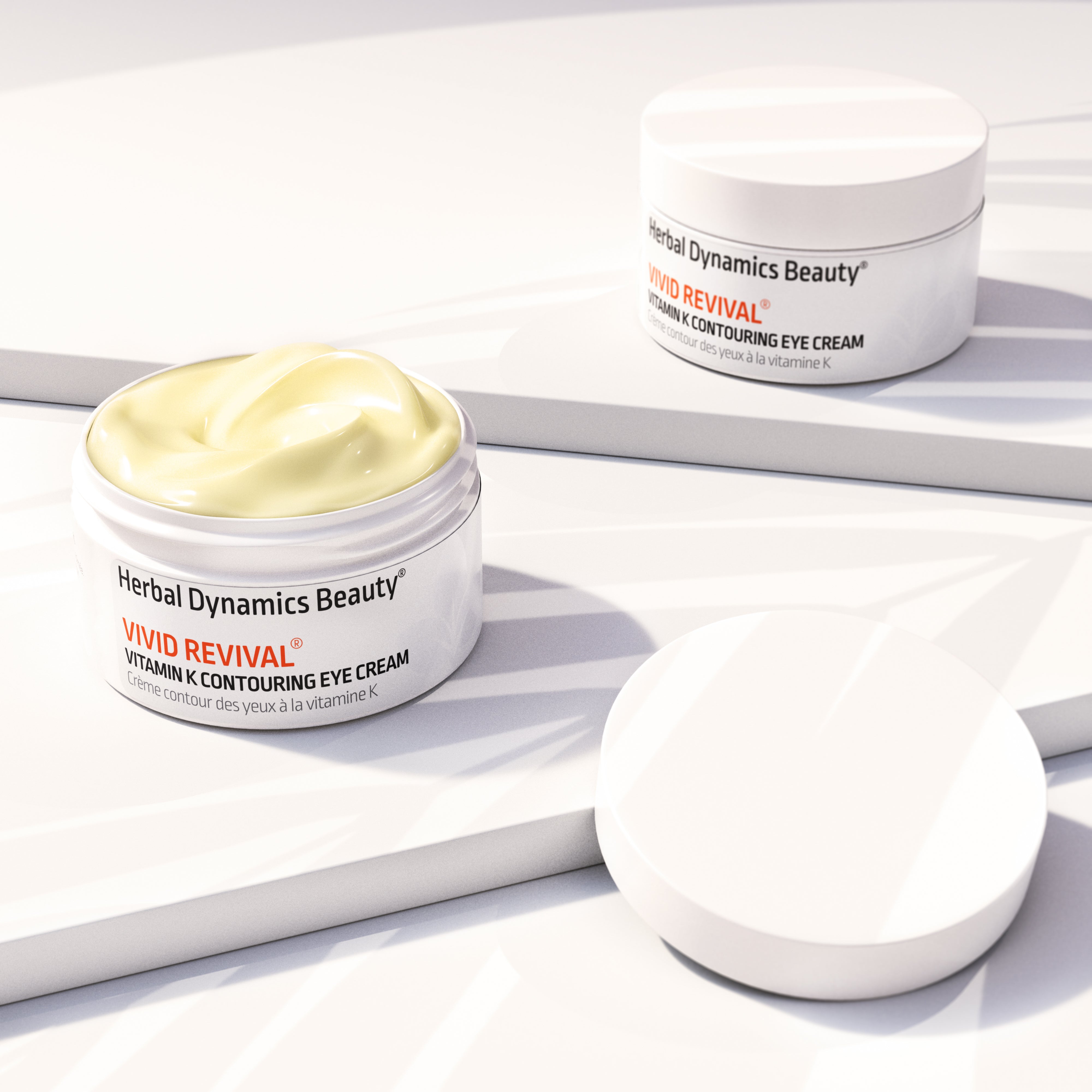
Herbal Dynamics Beauty Vivid Revival® Vitamin K Contouring Eye Cream lists phytomenadione in a moisturizing formula with green tea extract, aloe, glycerin, hyaluronic acid, oils, and other ingredients. It is a cosmetic intended to care for the appearance of the under-eye area; it is not a treatment for a vitamin deficiency, bleeding disorder, eczema, or an eye disease. As with any eye-area product, individual results and tolerance vary.
It may help the appearance of some dark circles, but the evidence is preliminary. Existing studies are small and often test vitamin K alongside caffeine, retinol, or other vitamins. Results are likely to depend on the cause of the darkness and the complete formula. For a product-by-product comparison organized by cause, see Herbal Dynamics Beauty's best eye creams for dark circles guide.
That is a common marketing explanation, but clinical evidence has not established that a cosmetic vitamin K product strengthens capillaries in a way that prevents ordinary dark circles.
Small trials suggest that certain topical vitamin K formulas may modestly improve laser-induced bruising after a procedure, but they did not consistently prevent bruising. Unexplained or frequent bruising should be evaluated medically.
There is no good evidence that increasing dietary vitamin K clears ordinary under-eye darkness in someone without a deficiency. Do not start a supplement for dark circles, especially if you take warfarin or another medication affected by vitamin K, without medical guidance.
There is no broadly accepted, evidence-based concentration for cosmetic dark circles. Studies have used different vitamin K forms, concentrations, vehicles, and combinations, so a higher percentage should not be assumed to work better or be safer.
This page covers vitamin K broadly. For the narrower dark-circle question, read what the studies show, what results may be realistic and how to use vitamin K eye cream safely. The dark-circle causes guide explains when vitamin K is—and is not—a logical fit.
The ingredient evidence answers a different question from choosing an everyday moisturizer. Use the eye-cream ingredient and benefits guide for the wider decision, then compare eye creams for puffiness, fine lines and dryness. For the combination with botanicals, read green tea around the eyes.
This page is for cosmetic education, not diagnosis or medical treatment. Seek medical care for sudden eye-area swelling, eye pain, vision changes, unexplained bruising, or a persistent rash.