Your Cart is Empty


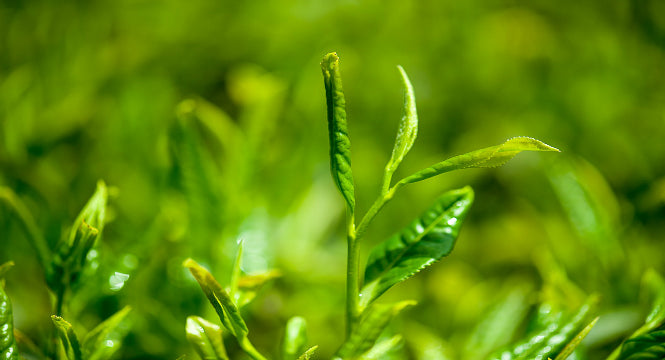
Green tea supplies polyphenols, including catechins such as EGCG, that researchers study for antioxidant activity and responses to environmental stress. Its value in a skincare product depends on the extract, formulation and outcome being measured. Laboratory activity alone cannot establish protection against everyday pollution or visible skin aging.
For ingredient identity, start with green tea for skin and the EGCG explainer. This guide focuses on what the antioxidant evidence can—and cannot—tell you.
Polyphenols are a broad family of compounds. Catechins form one group within it; EGCG is one particular catechin. Green tea is therefore a mixture, not a single standardized antioxidant molecule.
Experiments can examine chemical reactions, cell responses or tissue changes. Each answers a different question. A preparation that performs well in an antioxidant assay still needs to remain stable, reach the relevant part of skin and produce a useful outcome in people.
For the general meaning of oxidative stress, use the free-radical guide. Green tea's specific evidence should sit within that context rather than become a claim that every environmental exposure can be neutralized by a serum.
Elmets and colleagues applied green tea extract or individual constituents to volunteers' skin before experimental ultraviolet exposure. They reported changes in UV-response measures. This supports investigation of tea polyphenols, but it does not establish an SPF, a daily sunscreen alternative or long-term skin-cancer prevention by a retail cosmetic.
An experimental amount, application schedule and exposure cannot simply be replaced by an unspecified extract in a moisturizer. The same caution applies when interpreting a cell study as evidence of protection during a daily commute.
“Anti-pollution” is not a precise clinical endpoint by itself. Ask what was tested: particle deposition, a laboratory oxidation marker, visible irritation or changes in skin appearance. Improvement in one measure does not establish all the others.
Choose comfortable cleansing and moisturizing habits for your environment. Add an antioxidant product only if it serves your routine, and maintain appropriate sun protection. Do not mix an antioxidant serum into sunscreen; use each according to its own directions.
Evidence for visible outcomes is more limited than the biochemical rationale. A 2005 trial combining oral and topical green tea found tissue-level changes without a significant improvement in clinical grading. It could not isolate the effect of the topical product.
A moisturizing formula can make a dry surface look smoother or less dull. That is a reasonable cosmetic goal, but it should not be described as proof that green tea rebuilt collagen, repaired sun damage or reversed aging.
Prioritize a complete formula and a clear job. Herbal Dynamics Beauty Youth Refresh® Prickly Pear Antioxidant Daily Moisturizer includes Camellia sinensis leaf extract alongside emollients and other ingredients. It is an example of incorporating a botanical within a moisturizing step; ingredient evidence does not establish a finished-product UV or wrinkle result.
Read the stability guide before comparing extract percentages, and the selection guide before adding another bottle. For other antioxidant identities, the existing CoQ10, resveratrol and green tea comparison explains why a universal ranking is not supported.
By Herbal Dynamics Beauty · October 1, 2026