
Your Cart is Empty


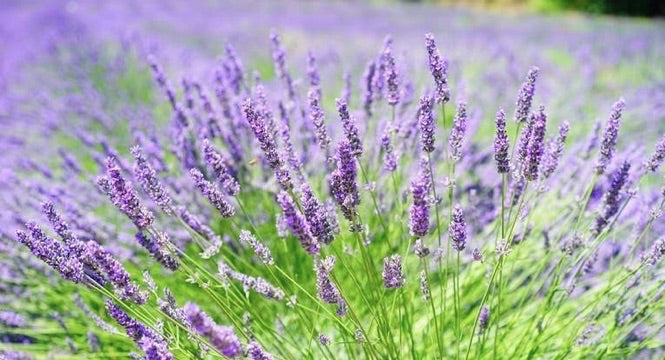
Lavender is commonly used for fragrance and appears in several kinds of cosmetic extract. Laboratory biological activity does not establish that a lavender cosmetic treats acne, heals wounds or rebuilds skin. A scented botanical can also cause irritation or allergic contact dermatitis.
There are many skincare products that use lavender as one of their ingredients. One primary reason for inclusion is to beautifully perfume the product, but other major benefits of lavender for skin care are the powerful cleansing and calming properties.
Lavender, most commonly found as Lavandula angustifolia (English lavender or Bulgarian lavender), is an evergreen shrub that blooms elegant purple flowers with an extraordinary scent.
The lavender plant grows in dry and hardy conditions and as such, is excellent as an all-year-round plant for your garden or landscaping. Lavender is generally planted in the spring to flower in the summer and can grow up to three feet in height. The lavender plant can survive for ten years if well-tended.
When the plant is finished blooming for the year, the blossom turns brown and the seed head appears. At this stage you can cut the head off along with the stem, tie a bag around the heads, leaving the stems sticking out. Leave them hanging upside down until the seeds have dropped out of the head.
The lavender seeds are dried out in a small paper bag until they are required. The seeds are needed to regrow more lavender for use in skincare products or for use as an herb in cooking.
With over 40 species of the lavender plant and over 400 varieties, how do you know which one is suitable for you? The most common species is the Lavandula angustifolia (English Lavender) and is used in topical skincare products.
There are other varieties sometimes seen in skincare, including Lavandula latifolia(spike lavender) and Lavandula stoechas (often called French or Spanish lavender), both of which are more applicable to respiratory or antimicrobial concerns. Another common species for inclusion in skincare products is Lavandula hybrida (which is a hybrid of any two varieties, but typically of Lavandula angustifolia and Lavandula latifolia).
With so many different varieties of lavender, you’ll find that there are some specific species with chemical compounds that are best used for other means than topical skincare.
The versatility of lavender makes it a favored ingredient to add to topical solutions. Products using lavender as an ingredient to neutralize the skin, control dryness, and plump-up the skin stretch across every step of a skin care routine from cleansers, to toners and serums, and finally, creams for the body and face.
Some lavender preparations show antimicrobial or antioxidant activity experimentally. That does not establish removal of pore bacteria or excess oil in clinical use, or justify describing an ordinary cosmetic as neutralizing the skin.
Topical lavender is not established as a way to add oxygen to skin cells or trigger regeneration. Normal tissue biology and a cosmetic ingredient claim require separate evidence.
A moisturizer can make dry surface lines less noticeable through its complete formulation. Lavender’s presence does not establish improved circulation or a proven anti-aging effect.
A lavender product’s pH and moisturizing effects depend on its complete formula. Lavender oil does not automatically balance sebum or remove dry patches, and fragranced products can be unsuitable for reactive users.
You might even see lavender oil marketed for spot-treating, but essential oils dabbed onto skin in their pure form (without a carrier oil) can be too concentrated and skin may react, so this is not usually recommended.
Laboratory antimicrobial and anti-inflammatory findings do not establish that lavender oil cleans out pores, treats acne or heals scars. Acne involves follicles, sebum and inflammation, and fragranced botanicals can irritate some users.
Experimental anti-inflammatory findings cannot establish infection control or new tissue formation in people using an ordinary lavender cosmetic. Persistent redness can have different causes and may need assessment.
A study involving surgical care or a particular preparation should not become an instruction to apply a fragranced oil to a wound. Cosmetic use on intact skin and postoperative treatment are different settings.
Antioxidant activity does not establish exfoliation, new cell production or a reliable barrier against pollutants. Choose the product for a demonstrated cosmetic purpose rather than assume lavender supplies every mechanism.
Laboratory antimicrobial activity is insufficient to demonstrate preservation of a complete water-containing product. A finished formula needs an appropriate preservation system and testing; lavender oil is not a universal replacement.
The scent of the lavender plant is used in many nighttime skincare products to give a calming effect and to induce quality sleep. Throughout the years lavender has become famous for helping you to achieve a calm state and better sleep (by relaxing your body).
A great deal of sleep-promoting products use lavender as a base ingredient to promote that lavender helps to relax muscles, calm your nerves, and get started on a good night’s sleep.
There is no adequately specified study here supporting a universal “20% more sleep” benefit from lavender skincare. Studies of particular aromatherapy exposures cannot establish the same result for every cream or every person.
Lavender doesn’t really make you fall asleep, it promotes relaxation in your mind and body. When your mind and body are relaxed, you can fall asleep. So, using lavender products to help you relax doesn’t hurt, but don’t expect it to be a magic potion and send you to sleep immediately.
Extraction changes the material, but a lavender extract can still contain fragrance components. The actual method and composition determine exposure; an extract label does not establish that the scent or allergens have been removed.
Organic certification is not a guarantee of zero pesticide exposure, superior purity or freedom from allergens. Evaluate the supplier’s quality controls and the finished formula rather than treat the label as proof of safety.
A small percentage of the population do suffer from a lavender allergy, so you should be certain you’re not reactive to lavender oil before adding any skincare products that contain lavender to your daily routine. A good place to test a new product for a potential reaction is on the skin on the inside of the forearm as it is similar to skin on the face.
Lavender essential oils and extracts differ in composition, but neither can be promised free of irritants or allergens. If you have a diagnosed fragrance allergy, follow your clinician’s avoidance advice rather than assume the extract form is safe.
Lavender may contribute scent or other formulation functions. It is not an automatically suitable choice for every face or body; people with reactive skin may prefer fragrance-free formulas and should stop a product that causes a reaction.
FDA’s fragrance guidance explains why natural scent ingredients can cause reactions. For a practical routine, use sensitive-skin guidance before selecting a botanical fragrance.
Content updated October 8, 2026.






