Your Cart is Empty


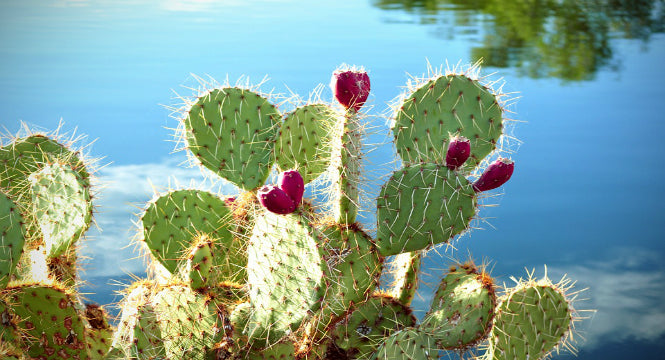
Prickly pear seed oil can act as an emollient, helping rough skin feel softer. Prickly pear extracts and seed oil are different ingredients, and neither automatically makes a product more hydrating than another moisturizer. The finished formula matters: water-binding ingredients, emollients and a suitable protective finish work together.
| Ingredient | What the name tells you | What it does not establish |
|---|---|---|
| Opuntia ficus-indica seed oil | Oil obtained from prickly pear seeds | A clinical wrinkle, pigment or acne result |
| Opuntia ficus-indica extract | An extract from the named plant; check the full ingredient name | The same composition as seed oil |
| A prickly pear moisturizer | A finished formula containing one or more prickly pear ingredients | That prickly pear alone accounts for all its effects |
The plant part, growing conditions and extraction method can change the composition. Comparing every cactus ingredient as if it were the same oil makes the evidence less useful.
Published chemical analyses identify fatty acids and tocopherols in prickly pear seed oil. Recent studies also report antioxidant activity in laboratory assays. Those results describe a material under test conditions; they do not prove that applying a particular face cream prevents skin aging or reverses sun damage.
The practical cosmetic reason to consider the oil is its emollient role. Reliable claims about reduced wrinkles, improved pigmentation or long-lasting hydration would require appropriate testing of the finished product. Do not transfer results from eating prickly pear, testing an extract in cells or measuring an oil in a laboratory directly to a facial moisturizer.
A pure oil does not provide the water and water-binding ingredients found in many creams. It may make a surface feel more supple, but a dry face may need a complete moisturizer. See face oil versus moisturizer for the difference between adding oil and replacing your cream.
For a tight or flaky face, start with gentle cleansing and a suitable moisturizer. If oil alone leaves the face uncomfortable, use the dry-skin moisturizer guide rather than adding more layers of the same oil.
Youth Refresh® Prickly Pear Antioxidant Daily Moisturizer lists both prickly pear extract and seed oil, alongside glycerin, shea butter and other emollients. That combination is more informative than the botanical name alone. It also lists ethyl ascorbic acid, a vitamin C derivative, and retinyl palmitate, a vitamin A derivative.
Consider it as a botanical daily moisturizing option if you tolerate the complete formula. Choose an alternative if you avoid retinoids or a listed ingredient. It is not sunscreen, and the ingredient list does not establish a guaranteed brightening result. The antioxidant moisturizer guide explains how to evaluate radiance claims.
Prickly pear seed oil is a plant oil with a mixture of components; squalane is a specific emollient ingredient. They may feel different in a finished product, but neither is universally better. There is not a sound basis here for ranking them by a promised collagen increase or a fixed pore-clogging score.
Choose by texture, tolerance and whether you need an oil at all. Test one new product at a time, and stop using it if it causes persistent irritation or breakouts. Botanical origin is not a guarantee against allergy.
If you are choosing between emollient types, compare squalane with jojoba and rosehip oil to understand how a purified hydrocarbon differs from botanical lipid mixtures. For squalane specifically, the product selection guide connects that ingredient choice to a useful formula format.
By Herbal Dynamics Beauty · Updated September 21, 2026.