Your Cart is Empty


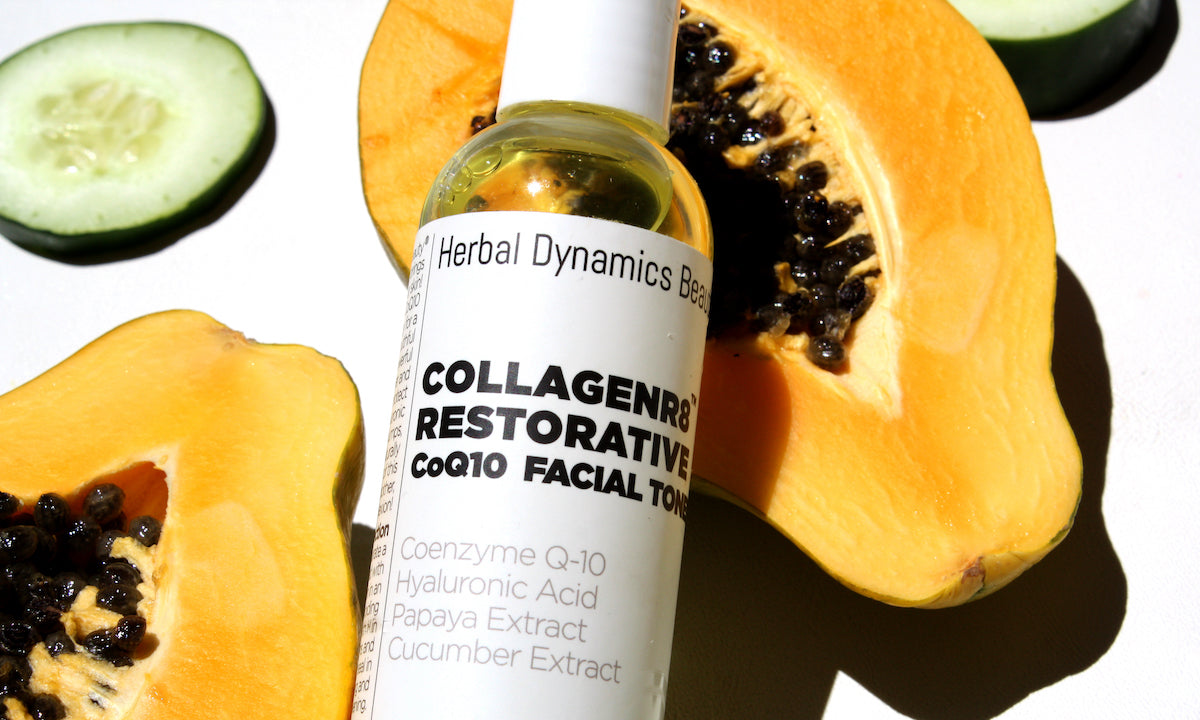
CoQ10 and vitamin E are different lipid-associated antioxidants, and both can appear in skincare. They share an antioxidant context, but their chemical identities and formulations differ. The most useful choice is between finished products that meet your goal, rather than a blanket ranking of the ingredients.
Start with CoQ10's role in skin and the vitamin E guide for the separate ingredient backgrounds.
| Term | What it identifies | What it does not establish |
|---|---|---|
| Ubiquinone | A common CoQ10 form in cosmetics | The amount delivered by a toner or cream |
| Ubiquinol | The reduced form of CoQ10 | Superior results from every product using that form |
| Tocopherol | A vitamin E ingredient name | A clinical outcome from the whole formula |
| Tocopheryl Acetate | An ester form used in cosmetics | Interchangeability with every study of tocopherol |
The form matters when matching a label to research. A result from a preparation containing tocopherol cannot simply be assigned to every moisturizer listing tocopheryl acetate. Similarly, CoQ10 presence does not tell you whether the product reproduces a tested research vehicle.
Antioxidant ingredients can be studied together, but evidence belongs to the tested combination and conditions. For example, research on vitamin C, vitamin E and ferulic acid examined a specific formulated system. It does not prove that adding any CoQ10 product to any vitamin E cream creates an equivalent effect.
A formula can also contain an antioxidant partly to support the product itself. Seeing an ingredient on the list does not reveal its intended role, concentration or contribution to visible skin results.
A vitamin E cream may feel rich because of its oils, emollients and other ingredients. A CoQ10 toner may feel light because of its overall vehicle. Those textures should not be attributed solely to vitamin E or CoQ10.
If dryness is your priority, assess whether the moisturizer is sufficient. The antioxidant moisturizer guide explains why the base should earn its place before additional antioxidant claims. If you prefer a separate light layer, use the CoQ10 format comparison.
No ingredient checklist requires both. A comfortable routine can be complete without a dedicated product for every antioxidant. Check what is already in your moisturizer before buying an additional step whose only purpose is to add vitamin E.
If you choose to include both, follow the finished products' directions and introduce changes gradually. Their antioxidant roles do not guarantee that two formulas will feel good together. Pilling, unwanted shine or discomfort may be practical reasons to simplify.
That requires evidence for the specific formulas and the outcome being compared. Antioxidant chemistry alone cannot rank wrinkle improvement. Read the CoQ10 and fine-lines evidence guide before using a laboratory mechanism as a cosmetic promise.
For product choice, the CoQ10 selection guide covers form, evidence and routine fit. The compatibility guide covers combining ingredients without assuming extra layers are essential.
By Herbal Dynamics Beauty · September 30, 2026