Your Cart is Empty


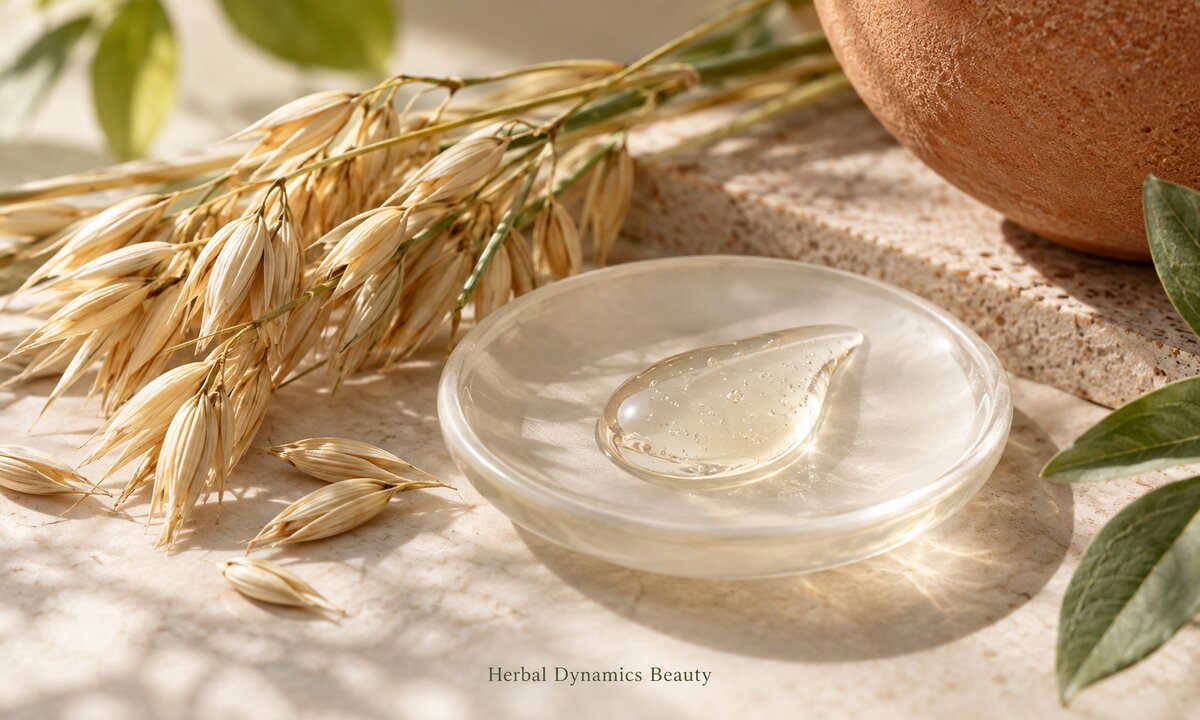
Oat beta-glucan is a glucose-based polysaccharide fraction found in oats, botanically Avena sativa. In suitable skincare formulations it can contribute moisturizing, conditioning and texture-related functions. It is one part of the oat material, so evidence for an oat extract or whole colloidal oatmeal cannot automatically be assigned to isolated beta-glucan.
Oat beta-glucan commonly has mixed β-(1,3) and β-(1,4) linkages in a generally linear chain. Its water interaction and solution properties depend on the preparation. The polymer can influence viscosity and film behavior as well as water retention; a raw-material measurement does not establish how an entire facial cream performs.
| Label or material | What it establishes | What remains unconfirmed |
|---|---|---|
| Beta Glucan with oat source disclosed | A named polysaccharide and a stated source. | Purity, molecular profile and concentration unless separately provided. |
| Avena Sativa Kernel Extract | An oat-kernel extract. | A standardized amount or identical form of isolated beta-glucan. |
| Avena Sativa Kernel Oil | An oat-derived oil ingredient. | An isolated beta-glucan disclosure. |
| Colloidal oatmeal | A processed whole-oat mixture with multiple components. | Equivalence to a purified beta-glucan preparation. |
The existing oat-ingredient guide covers the broader extract and oil categories. Beta-glucan versus colloidal oatmeal addresses the whole-mixture distinction and skin-protectant labeling.
Oat beta-glucan has topical research, including a brief early penetration and fine-line report and recent work in deliberately laser-treated test sites. Those settings answer different questions from ordinary daily moisturization. Material identity, vehicle, skin condition and comparator determine how useful a finding is for a cosmetic choice.
A hydration measurement does not prove lasting barrier restoration, and a wound-related mechanism does not establish that an oat beta-glucan cosmetic treats dermatitis or heals injuries. The evidence guide examines the human reports and their limitations in one place.
A comfortable formula may suit some people with sensitive-feeling skin, but source alone cannot predict a reaction. Oat-sensitization research in selected children with atopic dermatitis is relevant to caution around known allergy; it does not supply a general-population allergy rate or prove that every purified beta-glucan contains the same residual proteins.
With known oat allergy or a recurrent rash, ask an appropriate clinician before choosing an oat-derived formula. An at-home product test does not settle that allergy question. Other ingredients in the finished product also need review.
For ordinary dryness, assess whether the product also provides the emollient and moisture-retention support you need. A light oat beta-glucan serum can be optional beneath moisturizer; a suitable cream may already fill the moisture step. Follow the product directions rather than treating oat origin as a reason to increase frequency.
The dryness guide applies that decision to tight or flaky skin. The source comparison explains why an oat preparation should not be ranked against an unspecified yeast ingredient.
By Herbal Dynamics Beauty · Reviewed October 5, 2026.